August 25, 2022
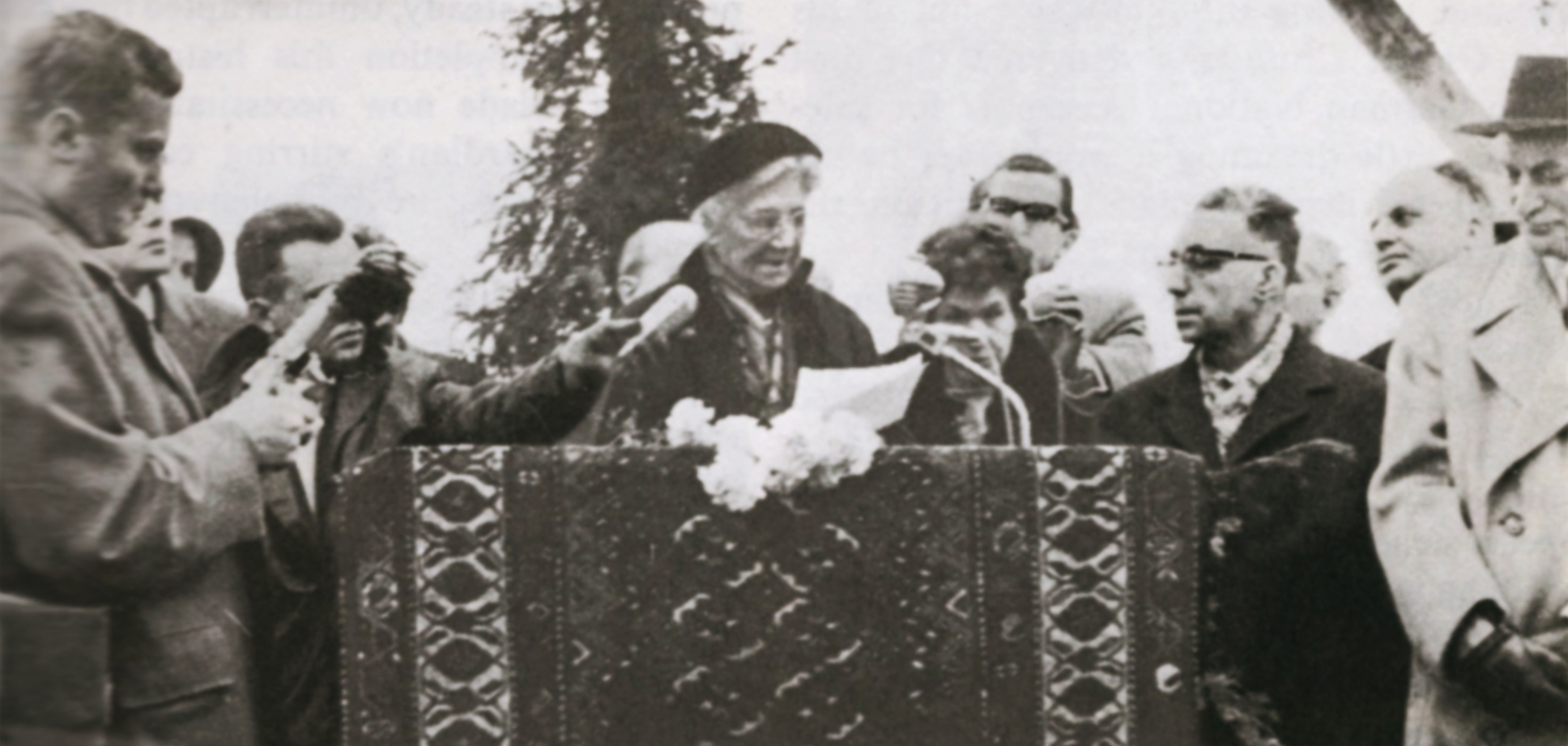
1960: Laying the Foundation Stone for the Mother Temple of Europe

August 10, 2022
1909: Delegates to the first nationwide Baha'i Convention
 |
| These delegates established the Baha'i Temple Unity for the construction of the Mashriqu'l-Adhkar in Chicago. |
July 15, 2022
The tragic fate of Quddús
Quddús, their beloved leader, was by yet another shameful act of the intimidated Prince surrendered into the hands of the diabolical Sa‘idu’l-‘Ulamá who, in his unquenchable hostility and aided by the mob whose passions he had sedulously inflamed, stripped his victim of his garments, loaded him with chains, paraded him through the streets of Bárfurúsh, and incited the scum of its female inhabitants to execrate and spit upon him, assail him with knives and axes, mutilate his body, and throw the tattered fragments into a fire.
- Shoghi Effendi (‘God Passes By’)
June 30, 2022
Some awe-inspiring “salient features” of the dawn-breakers at Fort Tabarsi – summarized by Shoghi Effendi
It will be unnecessary to attempt even an abbreviated narrative of this tragic episode, however grave its import, however much misconstrued by adverse chroniclers and historians. A glance over its salient features will suffice for the purpose of these pages.
- We note, as we conjure up the events of this great tragedy, the fortitude, the intrepidity, the discipline and the resourcefulness of its heroes, contrasting sharply with the turpitude, the cowardice, the disorderliness and the inconstancy of their opponents.
- We observe the sublime patience, the noble restraint exercised by one of its principal actors, the lion-hearted Mullá Husayn, who persistently refused to unsheathe his sword until an armed and angry multitude, uttering the foulest invectives, had gathered at a farsang’s distance from Bárfurúsh to block his way, and had mortally struck down seven of his innocent and staunch companions.
- We are filled with admiration for the tenacity of faith of that same Mullá Husayn, demonstrated by his resolve to persevere in sounding the adhán, while besieged in the caravanserai of Sabsih-Maydán, though three of his companions, who had successively ascended to the roof of the inn, with the express purpose of performing that sacred rite, had been instantly killed by the bullets of the enemy.
- We marvel at the spirit of renunciation that prompted those sore pressed sufferers to contemptuously ignore the possessions left behind by their fleeing enemy; that led them to discard their own belongings, and content themselves with their steeds and swords; that induced the father of Badí‘, one of that gallant company, to fling unhesitatingly by the roadside the satchel, full of turquoises which he had brought from his father’s mine in Níshápúr; that led Mírzá Muhammad-Taqíy-i-Juvayní to cast away a sum equivalent in value in silver and gold; and impelled those same companions to disdain, and refuse even to touch, the costly furnishings and the coffers of gold and silver which the demoralized and shame-laden Prince Mihdí-Qulí Mírzá, the commander of the army of Mázindarán and a brother of Muhammad Sháh, had left behind in his headlong flight from his camp.
- We cannot but esteem the passionate sincerity with which Mullá Husayn pleaded with the Prince, and the formal assurance he gave him, disclaiming, in no uncertain terms, any intention on his part or that of his fellow-disciples of usurping the authority of the Sháh or of subverting the foundations of his state.
June 20, 2022
The eleven-month contest at Fort Tabarsi

- Shoghi Effendi (‘God Passes By’)
June 12, 2022
Growth of the Faith between 1953 and the launching of the Nine Year Plan in 1964: 12 NSAs and slightly more than 600 LSAs to 70 NSAs and 4600 LSAs
Once more, dear friends, we enter the battle but with an incomparably greater array than that which embarked upon the World Crusade in 1953. To that small force of twelve national communities, now veteran campaigners, have been added fifty-seven new legions, each under the generalship of a National Spiritual Assembly, each destined to become a veteran of this and future campaigns. That Crusade began with slightly more than six hundred Local Spiritual Assemblies, the greater part of which were situated in Persia, North America and Europe; the home-fronts now comprise nearly four thousand six hundred Local Spiritual Assemblies scattered throughout the continents and islands of the world. We begin this Plan with a tremendous momentum, exemplified by the addition, since last Ridvan, of over four thousand new centres and thirteen National Spiritual Assemblies, and by the beginning, in several countries, of that entry by troops into the Cause of God prophesied by 'Abdu'l-Baha and so eagerly anticipated by Him.
- The Universal House of Justice (Message to the Baha'is of the world, April 1964; ‘Messages from the Universal House of justice 1963-1986’)
June 1, 2022
Growth of the Faith between 1957 to 1975
In the eighteen years since that achievement, [the completion of the International Archives Building in 1957] the community of the Most Great Name has grown rapidly in size and influence:
- from twenty-six National Spiritual Assemblies to one hundred and nineteen,
- from some one thousand to seventeen thousand Local Spiritual Assemblies,
- and from four thousand five hundred localities to over seventy thousand…
- The Universal House of Justice (From a message dated 5 June
1975; ‘Messages from the Universal House of Justice 1963-1986’)
May 25, 2022
1975: Fiftieth anniversary of the establishment of the National Spiritual Assembly of the United States
24 April 1975
To the National Spiritual Assembly of the Baha'is of the
United States
PORTENTOUS OCCASION FIFTIETH ANNIVERSARY FORMAL
ESTABLISHMENT NATIONAL SPIRITUAL ASSEMBLY BAHA'IS UNITED STATES RECALL WITH
PRIDE ADMIRATION PRE-EMINENT STATION CONFERRED AMERICAN BAHA'I COMMUNITY CENTRE
COVENANT PREPONDERATING ROLE ALREADY ASSUMED WORLD-WIDE PROMOTION FAITH
GLORIOUS ACHIEVEMENTS UNMATCHED RANGE MAGNITUDE ENTIRE BAHA'I WORLD PAST HALF
CENTURY. CALL UPON THIS HIGHLY BLESSED DISTINGUISHED COMMUNITY CONTEMPLATE ITS
UNDOUBTED DUTIES PRIVILEGES PURGE ITS SOUL ALL WORLDLY ENTANGLEMENTS REDEDICATE
ITS ENERGIES RESOURCES IMMEDIATE TASKS ARISE SINGLE-MINDEDLY PERFORM HISTORIC
MISSION RENDER SUCH SERVICES ATTAIN SUCH SACRIFICIAL HEIGHTS WORTHY BRILLIANT
FOREBEARS HEROIC AGE FAITH.
UNIVERSAL HOUSE OF JUSTICE
(Messages from the Universal House of Justice, ‘1963-1986’)
May 12, 2022
The condition of the government of Persia at the time of the Báb’s “formal assumption… of the authority of the promised Qá’im”

- Shoghi Effendi (‘God Passes By’)
April 5, 2022
January 1975: Acquisition of the house of 'Abdu'llah Pasha' in 'Akka – birthplace of Shoghi Effendi
 |
| 1920s (Baha’i Media Bank) |
UNIVERSAL HOUSE OF JUSTICE (Messages from the Universal House of Justice, ‘1963-1986’)
March 26, 2022
1848: First "systematic campaign" against the Faith by civil and ecclesiastical powers combined

- Shoghi Effendi (‘God Passes By’)
March 17, 2022
1848-1850: “the bloodiest and most dramatic of the Heroic Age of the Bahá’í Era”

- Shoghi Effendi (‘God Passes By’)
March 10, 2022

February 26, 2022
May 25, 1944: 50th Anniversary of Founding of Baha'i Faith in Western World

Hotel Stevens, Chicago, Illinois (Baha’i News, September
1944)
February 16, 2022

February 7, 2022
1962: First National Convention of the Baha'is of Finland, Helsinki

Attended by Hand of the Cause Adelbert Muhlschlegel
(The Baha'i World 1954-1963)
January 22, 2022
1957: First National Convention of the Baha'is of South East Asia, Djakarta, Indonesia
 |
| Attended by Hand of the Cause 'Ali Akbar Furutan (The Baha'i World 1954-1963) |
January 12, 2022
1992: The Baha’i Faith "is represented in every country on earth”

- The Universal House of Justice (Ridvan 1992 message)
December 30, 2021
1990: Formation of Local Spiritual Assemblies in Soviet Union, Romania, Czechoslovakia, Hungary and Yugoslavia

To the Followers of Bahá’u’lláh throughout the World
SEVEN MONTHS AFTER LAUNCHING SUPPLEMENTARY TWO YEAR PLAN REJOICE ANNOUNCE FOURTEEN LOCAL SPIRITUAL ASSEMBLIES IN SOVIET UNION, PLUS SIX IN ROMANIA WHERE THERE ARE NOW OVER 600 BELIEVERS, AND ONE LOCAL SPIRITUAL ASSEMBLY EACH IN CZECHOSLOVAKIA, HUNGARY AND YUGOSLAVIA. DEVELOPMENT FAITH IN ALL THESE COUNTRIES AS WELL AS IN ALBANIA, BULGARIA, MONGOLIA AND POLAND GOING FORWARD WITH EXTRAORDINARY SPEED, FORMATION MORE LOCAL ASSEMBLIES IN PROCESS OR EXPECTED SHORTLY.
The Universal House of Justice
(Messages from the Universal House of Justice 1986-2001)
December 20, 2021
1991: German Federal Constitutional Court “affirmed the right of the Bahá’í community to gain legal capacity in the very shape ordained in the scriptures of the Bahá’í Faith”

- The Universal House of Justice (Ridvan 1991 message; Messages from the Universal House of Justice 1986-2001)
December 10, 2021
1988-1990: “almost one million souls entered the Cause”

- The Universal House of Justice (Ridvan 1990 message; Messages from the Universal House of Justice 1986-2001)
November 16, 2021
1990: Establishment of "The Bahá’í Chair for World Peace"

To the Bahá’ís of the World
With feelings of thankfulness and joy we announce an achievement
of immense importance to the accelerating progress of the Cause of Bahá’u’lláh.
The University of Maryland and the National Spiritual Assembly of the Bahá’ís
of the United States recently signed a memorandum of understanding,
establishing "The Bahá’í Chair for World Peace" at that University's
Center for International Development and Conflict Management. The stated
purpose of the Chair is "to conduct and publish research, design courses
and conduct seminars in the field of Bahá’í studies and world peace within an
interdisciplinary context; to initiate public forums for discussing the issues
proposed in the Statement of the Universal House of Justice entitled The
Promise of World Peace; and to establish academic linkages with and provide
technical assistance to Bahá’í institutions in the fields of peace education
and international development."
This first initiative by a well-founded, significant institution of higher learning to formulate such a serious program of Bahá’í studies is a direct response to the Peace Statement, as is borne out by a letter addressed to us by the Director of the Center for International Development and Conflict Management in which he said: "With this letter I am answering on behalf of CIDCM and the University of Maryland your call: 'If the Bahá’í experience can contribute in whatever measure to reinforcing hope in the unity of the human race, we are happy to offer it as a model for study.'"
November 2, 2021
Events witnessed during the “last three and most eventful years of the Báb’s ministry”

- Shoghi Effendi (‘God Passes By’)
October 15, 2021
July 1974: Members of Continental Pioneer Committees “will henceforth be appointed by the Universal House of Justice”

To all National Spiritual Assemblies
Dear Baha'i friends,
In view of the ever-increasing number of pioneers and travelling teachers now arising from various countries to serve the Cause of God in widely scattered lands throughout all continents the Universal House of Justice has considered ways of deriving maximum benefit from the services of these devoted believers, co-ordinating their efforts and anticipating the needs of the future.
The Continental Boards of Counsellors will soon be approaching you about the need for pioneers and travelling teachers for the period ending Ridvan 1976.
The functions of the Continental Pioneer Committees have been reviewed and developed in a way that will enable them to operate in closer collaboration with the Continental Boards of Counsellors and the National Spiritual Assemblies of their areas. A copy of the statement outlining the functions of the Continental Pioneer Committees as now revised is attached for your information. As you will note, the members of these Committees will henceforth be appointed by the Universal House of Justice. Nothing in the functions now assigned to the Continental Pioneer Committees in any way detracts from the primary responsibility of National Spiritual Assemblies to foster and promote pioneering and travelling teaching.
It is our hope and prayer that as the Five Year Plan unfolds evidences of closer ties of co-operation among the various institutions of the Faith will be increasingly witnessed in every land.
With loving Baha'i greetings,
The Universal House of Justice
(Messages from the Universal House of Justice, ‘1963-1986’)
October 1, 2021
June 1845 - Shiraz: First direct interaction between the Báb and the clergy

- Nabil (‘The Dawn-Breakers’, translated and edited by Shoghi Effendi)
[1] Qur’án, 49:6 - “If any bad man come unto you with news,
clear up the matter at once, lest through ignorance ye harm others, and be
speedily constrained to repent of what ye have done.”
[2] The Governor’s attendant had struck the Báb in the face
so violently that His turban had fallen to the ground. [adapted from ‘The
Dawn-Breakers’]
Subscribe to:
Posts (Atom)